
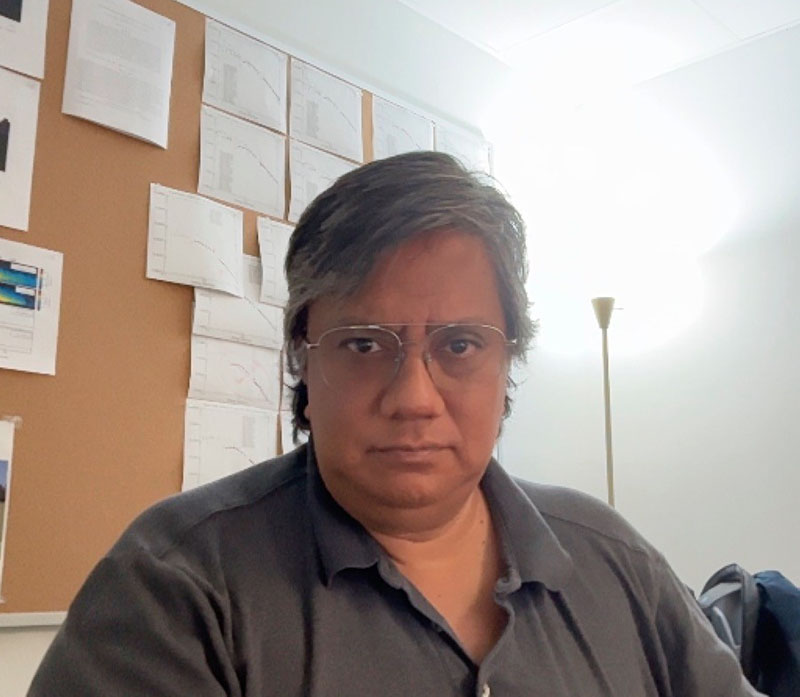
Over many years, Allan Labrador has worked on a variety of space physics experiments, focusing on galactic and solar cosmic rays. He has been a member of science and instrument teams for the high-altitude balloon-borne experiments IMAX, HEAT-pbar, and SuperTIGER, and he has also been a member of science and instrument teams for SAMPEX, ACE, STEREO, and Parker Solar Probe. For most of these experiments, he has participated in all stages from detector development, testing, and construction, through integration and flight, and to science data analysis, public presentation, and publications. His work on instrument development, testing, and construction included aerogel Cherenkov detector development and assembly on IMAX and SuperTIGER, and construction and testing of large volume multiwire proportional counters (MWPCs) on HEAT-pbar. He has participated as a member of the accelerator run teams for several of these instruments at the 88 inch Cyclotron at LBNL, and at the accelerators at TAMU and MSU, usually leading data acquisition and distribution of data to the rest of the teams. At various times, he has contributed to development of thin silicon detectors to push future development of silicon detector telescopes to lower threshold energies. The thin Si work includes recent lab tests of 6 micron thick silicon detectors under exposure to Cm244 and Th228.
His analytical work has included analysis of IMAX and HEAT-pbar data for measuring galactic cosmic ray antiproton abundance, and he has also pursued measurements of solar energetic particle charge states using the geomagnetic rigidity cutoff technique in SAMPEX data as well as inferred ionic charge states using ACE/SIS and STEREO/LET data. He developed the solar energetic particle electron-response matrices for the HET instrument for EPI-Hi on PSP using extensive Geant4 simulations Looking forward, future data analysis efforts will include continuing his investigation of high-energy ionic charge states in solar energetic particle events and implementing machine learning techniques to analyze and survey SEP event time profiles across multiple spacecraft missions. This work will be applied to publicly available data sets, including data from ACE, STEREO, and Parker Solar Probe.